Cart
0

You mention boric acid to your gynecologist and immediately hear:
“I don’t recommend boric acid.”
Then you go online and see thousands of women talking about boric acid suppositories for vaginal health.
So naturally, you’re confused.
Is boric acid actually bad for you? Why would some gynecologists advise against it while boric acid is still discussed in clinical guidance for certain vaginal conditions?
The answer is more nuanced than a simple yes or no.
First: Your Gynecologist Isn’t Necessarily Wrong
There are good reasons for a healthcare professional to be cautious about boric acid.
One of the biggest is self-diagnosis.
Fishy odor? BV.
Thick discharge? Yeast.
Something feels different? Boric acid.
Unfortunately, vaginal health isn't that simple.
Similar symptoms can have completely different causes, including bacterial vaginosis, yeast infections, sexually transmitted infections, irritation, hormonal changes and other vaginal conditions.
Treatment depends on what's actually causing the symptoms.
That's important because using any vaginal treatment for the wrong problem can delay getting the treatment you actually need.
But Here's Where the Conversation Gets Interesting…
Boric acid isn't something that exists only on TikTok, Instagram or feminine-care shelves.
It also appears in established clinical guidance.
The CDC's guidance for recurrent non-albicans vulvovaginal candidiasis includes 600 mg of boric acid administered vaginally once daily for three weeks when recurrence occurs after initial therapy.
Boric acid also appears in CDC guidance as part of a possible treatment approach for women experiencing multiple recurrences of bacterial vaginosis, although the CDC notes that the supporting data are limited.
So the conversation shouldn't really be:
“Is boric acid good or bad?”
A better question is:
“When is boric acid appropriate, and when isn't it?”
Boric Acid Isn't a Cure-All
This is where FemmeGlory believes responsible feminine-care education matters.
Boric acid shouldn't become the automatic answer every time something feels different.
Standard treatment for symptomatic bacterial vaginosis generally involves prescription medications such as metronidazole or clindamycin.
Likewise, common vaginal yeast infections are generally treated with antifungal medications. Boric acid has a more specific role in certain difficult or recurrent cases.
That's very different from:
“Use boric acid whenever your pH feels off.”
And it's an important distinction.
And Sometimes You Don't Need to Treat Anything
Not every change in discharge means something is wrong.
Not every vaginal odor means BV.
And not every temporary change after sex means you have an infection.
The vaginal environment can naturally fluctuate due to menstruation, sexual activity, hormonal changes, antibiotics, products and other factors.
Your body isn't supposed to smell or feel exactly the same every hour of every day.
Knowing what's normal for your body matters.
So Where Do FemmeGlory Products Fit In? 🌸
This is where we want women to think differently about feminine care.
Your feminine-care routine shouldn't revolve around one product.
Instead, think about understanding your body, supporting your routine and knowing when it's time to speak with a healthcare professional.
🌸 FemmeGlory pH Test Strips — KNOW
Before automatically reaching for a product because something feels different, start by becoming more familiar with your vaginal environment.
FemmeGlory pH Test Strips allow you to conveniently check vaginal pH at home.
A pH result cannot diagnose BV, yeast infections or STIs and a normal result doesn't rule out a problem but it can give you another piece of information about what's happening with your body.
Think of it as:
KNOW your pH. Don't guess your diagnosis.
If you have persistent odor, unusual discharge, itching, burning or pain, testing your pH should never replace appropriate medical evaluation.
🌸 FemmeGlory Daily Feminine Wash — CLEANSE
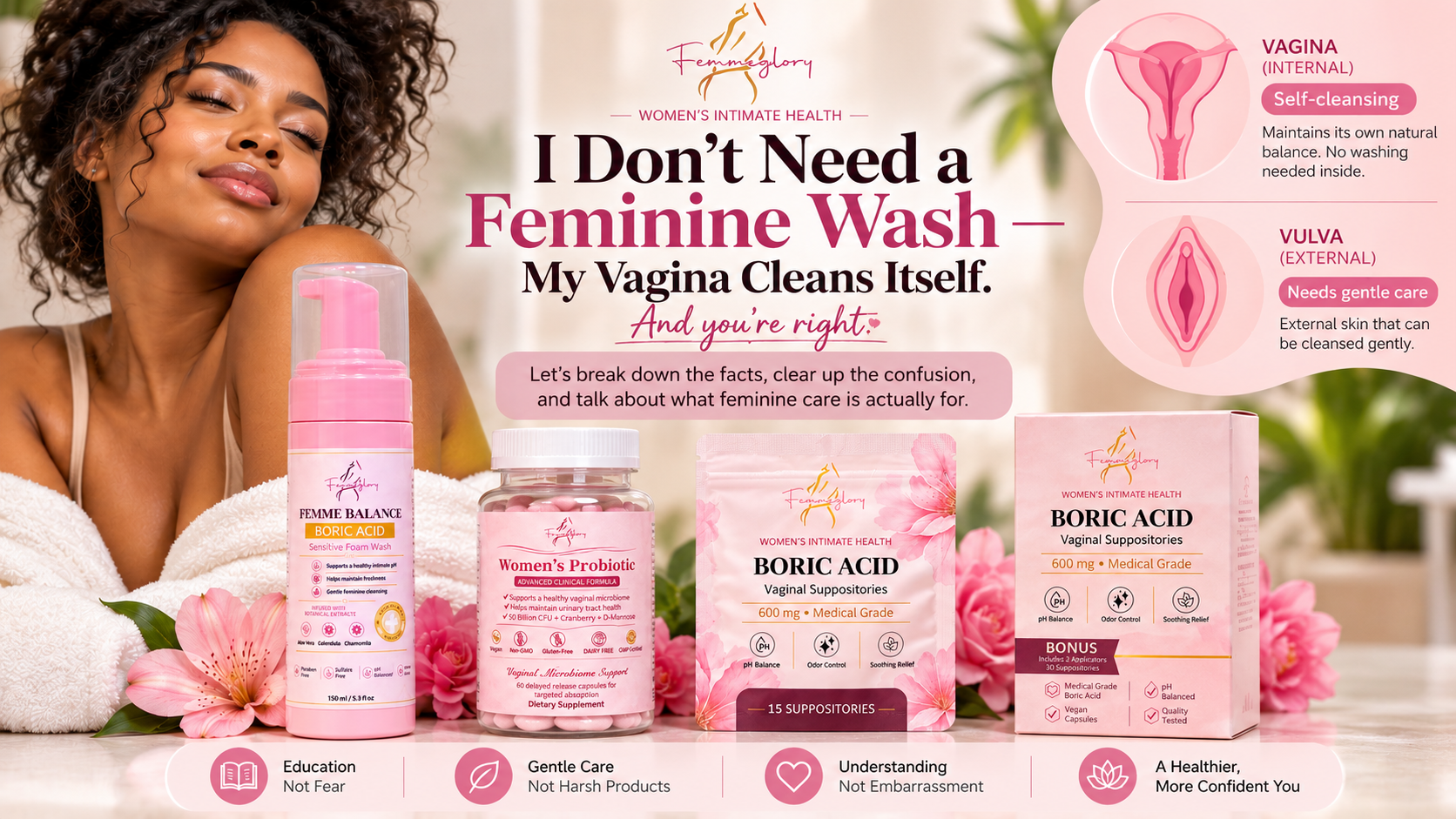
Feminine hygiene doesn't mean trying to wash inside the vagina.
The vagina is self-cleaning.
Your vulva, however, is external skin and can be gently cleansed.
FemmeGlory's Daily Feminine Wash is designed for external feminine hygiene as part of your everyday shower routine.
Think:
Gentle external cleansing — not disrupting what's happening internally.
No douching. No trying to scrub away your natural vaginal environment.
Just thoughtful everyday feminine hygiene.
🌸 FemmeGlory Women's Probiotic — SUPPORT
Your vaginal microbiome is an ecosystem.
That's why FemmeGlory's approach to feminine wellness goes beyond what you use externally.
Our Women's Probiotic 50 Billion CFU with D-Mannose and Cranberry was developed as a daily supplement to support women's vaginal, urinary and digestive wellness.
The important word here is:
SUPPORT.
A probiotic isn't a replacement for medication when you have an infection, and it shouldn't be marketed as one.
Instead, it's part of a broader daily wellness routine.
🌸 FemmeGlory Boric Acid Suppositories — TARGET
And then we come back to the product that started this entire conversation:
Boric acid.
FemmeGlory Boric Acid Suppositories contain 600 mg of boric acid per suppository for vaginal use.
But responsible feminine care means understanding that boric acid isn't something every woman needs simply because something feels different.
If you're experiencing recurrent vaginal symptoms, don't keep blindly treating yourself.
Find out what's actually happening.
And if your gynecologist tells you not to use boric acid, ask:
“Why isn't boric acid appropriate for me?”
There may be a very good reason based on your symptoms, diagnosis, pregnancy status, medications, medical history or another individual factor.
Boric acid should never be swallowed and should be kept away from children and pets. If you are pregnant or trying to become pregnant, speak with your healthcare professional before using vaginal boric acid.
KNOW. CLEANSE. SUPPORT. TARGET. 🌸
That's the FemmeGlory approach.
KNOW — Understand your vaginal environment with FemmeGlory pH Test Strips.
CLEANSE — Practice gentle external hygiene with FemmeGlory Daily Feminine Wash.
SUPPORT — Make vaginal, urinary and digestive wellness part of your daily routine with FemmeGlory Women's Probiotic.
TARGET — When boric acid is appropriate for you, understand what you're using and why you're using it.
Because feminine wellness shouldn't mean reaching for the strongest product every time something changes.
It should mean understanding your body.
So… Is Your Gyno Wrong About Boric Acid?
Not necessarily.
Your gynecologist knows your individual circumstances, and there may be a specific reason they don't recommend it for you.
But saying “boric acid has no place in vaginal health” would also overlook the fact that boric acid appears in established clinical guidance for certain situations.
The CDC includes intravaginal boric acid in guidance for certain recurrent non-albicans yeast infections and as one component of a possible regimen for women with multiple recurrences of BV.
Context matters. Diagnosis matters. And how you use a product matters.
So don't make it:
Your gynecologist vs. boric acid.
Make it:
“I understand my body, I understand my products, and I know when it's time to ask questions.”
That's what informed feminine care should look like.
FemmeGlory 🌸
Your Femmebestie
Feminine Care, Better Understood.
This article is for educational purposes only and is not intended to diagnose, treat, cure or prevent any disease. FemmeGlory pH Test Strips do not diagnose infections or other medical conditions. Dietary supplements are not substitutes for medical treatment. If you have persistent or recurrent vaginal symptoms, unusual discharge, strong odor, itching, burning, pelvic pain or other concerns, consult a qualified healthcare professional.